





Naïve techno-utopianism.
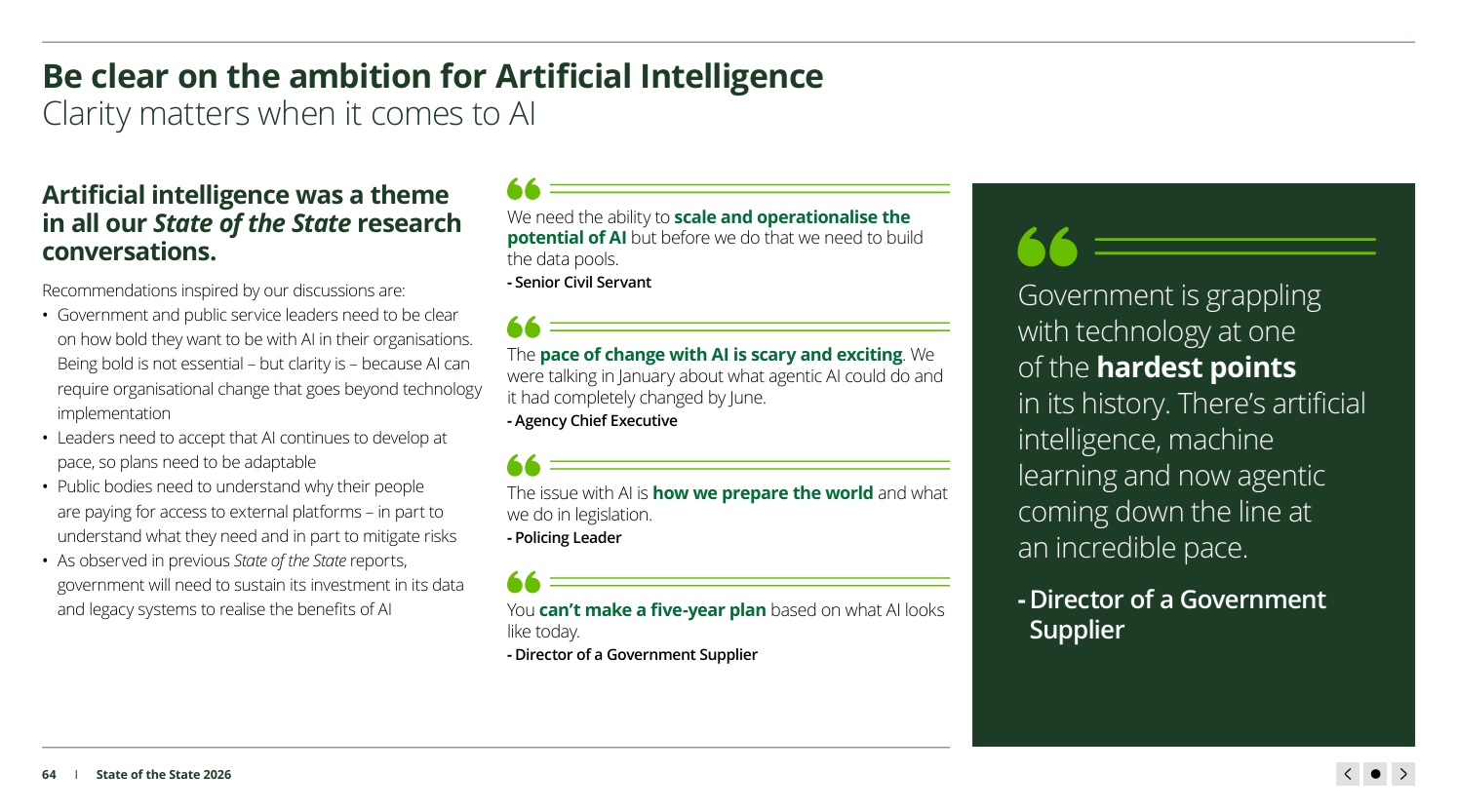
This, and other candid opinions, are combined from across118 senior civil servants in The State of the State report from Deloitte. Overlaid with responses from I excess of 5000 UK citizens and you get the temperature of what the thinking is across all aspects of the public sector.
There’s loads to unpack from the report but, staying in my lane, here is the summary of our thoughts on the key themes of delivery and AI.
Back to “naïve techno-utopianism.” What a line.
But it actually tells me something different from that intended.
Unintentionally, it's not actually an indictment of AI itself- it's an indictment of how AI is understood and how we're deploying it. That, for me, is the critical takeaway from the report.
1. Not if but how
Today, AI is truly inevitable. Just like the industrial revolution. Just like the advent of computers. There is no stopping it — get with it or be left behind.
I hear daily from CEOs being pressurised by their boards to "use AI." But that's like saying "use technology." It's broad, flaccid and unhelpful.
We need to think of AI like any other toolbox — different tools for different jobs. But before you reach for a tool, you have to be clear on what the job actually is that you need the tool for.
The question isn't whether. It's what, how, and how fast.
2. The public sector's pace problem.
There was a lot in the report about actual productivity gains or lack thereof.
The MIT State of AI report in May last year found only around 5% of productivity gains from AI are actually being realised. This report arguably reflects where we are today in the public sector, a year later.
The private sector has started to get its act together and is now moving at pace. We have fundamentally changed our hiring plan over the last three months thanks to extraordinary efficiencies from Claude Code.
Speaking with Anthropic last week — who build Claude — they aren't building for what's needed now. They're building for what will be needed in six months. The pace of change is extraordinary and unprecedented.
The difference in the public sector, and what’s going to really limit all productivity gains, is the pace of the procurement process.
There are some great strides bring taken — founders of Octopus Energy and Monzo coming together with government to drive AI strategy. But there is going to be nothing tangible from that, at best, in months.
G-Cloud just closed it’s window to apply in January. This is the “fast track” way to get through Government procurement. But the next window to even apply won’t open for over 18 months, which means the Government is 2 years away from even testing many of the new products and services on the market. Anyone want to guess what the world looks like in two years? Not me!
But what I can say is that Government departments won't have access to any of those technologies or providers. Just the ones already in play.
It’s time to overhaul procurement.
But I would channel you to also think about how to imaginatively manage through the procurement process in the interim. Government agencies can still go out to tender for suppliers not on G-Cloud. If you make the process simple, transparent and tight, it becomes actually feasible for smaller companies (and arguably more nimble and more cutting edge) to get through the process and deliver real solutions as soon as possible.
3. The citizen experience gap is becoming a crisis.
The gap between consumer experience and citizen experience is widening at speed.
People simply want things that work but also that meet expectation.
We accepted going to bank to cash a cheque. But, now that I am used to open banking, I would be pretty cross if I had to drive to a bank branch and queue again. What is “good enough” now for citizens will not be “good enough” tomorrow.
So whilst the priority is that (1) something works, you also need to think about whether (2) people will actually use the system, or revert to old process. And when they do use it, (3) how will they feel. Be prepared that what passes these three tests now, may not in 12 months time.
4. Clarity and delivery — that's the flywheel.
I'm genuinely optimistic about AI in public services.
Whilst fifty-one percent of the public cite reduced human contact as their top fear. I actually read that differently.
People don't want AI instead of humanity — they want AI to free up humans to actually be human. Not spend their days asking people their name and date of birth for the seven-hundredth time. Instead support them through understanding the right benefits for their family or sit with them when they have been mugged.
My brother's a policeman. Many of my friends are teachers and doctors. They all went into vocational roles because they wanted to do that job. What drives them mad is the adjacent admin. Imagine the public sector with admin handled more accurately, more reliably, and around the clock —freeing people up for the human things AI is decades away from being able to do.
Now for my one personal slight deviation from the report. The report says leaders need clarity on their AI ambition. Bold isn't mandatory — but clarity is. Agreed.
But I'd go further: the organisations that will win aren't the ones with the biggest budgets or the most transformational strategies. They're the ones that can deliver.
This means getting clear on a specific problem.
Choose the right type of AI to address it.
Deliver a result the public can actually see.
That builds trust. Trust drives adoption. Adoption drives momentum. That's the flywheel.
So don’t get wrapped up in AI strategy. Think AI deployment, now.
Action. Clarity. Outcomes.